
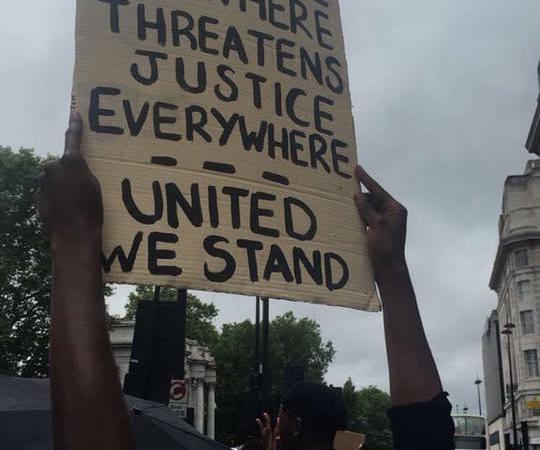
So there’s been a lot going on recently and it has resulted in protests, riots & rebellions around the world. As West Indians it’s important that we understand that we have BEEN protesting and rebelling for as long as we have been participating in carnival.
This post is an essay I wrote in my second year of uni, it’s an essay looking at how Carnival is a space for conflict, resistance, conviviality and consumption. And how it is a direct response to post-colonialism. Enjoy and remember, Black Lives (always have and always will) Matter!
–
Post-colonial theory emerged in the 20th century when various colonial subjects around the world began to fight for their independence. Post-colonial scholars looked to understand the effects of colonial rule on these countries. Post-colonial theory can be used to analyse practices undertaken in these former colonial countries, and this essay will use Carnival as a case study. It will focus on ‘Karnaval Defile’ – the Haitain carnival, and how it is a space for conflict, resistance, conviviality and consumption. The question of whether we are really in post-colonial times will also be discussed.
Western countries such as Great Britain, France and Spain were the most prolific colonisers during the 16th-18th centuries. They sent armies across the world to invade, pillage and overrule smaller, less powerful countries in Africa, Asia and other areas in a bid to become the most powerful empire. They would show off their work, Rule! Britannia being a prime example of this. The song boasts of the fact that Britain was immune to being colonised due to its might and grandeur; inadvertently calling those who had fallen to imperial rule weak. It was during the 20th century that we began to see the fall of these empires. Colonies started to fight for and gained their independence. This is when post-colonial theory came to being, Chinua Achebe’s Things Fall Apart (1958) was the first major English book on the topic, it tells the (fictional) story of life in post-colonised Nigeria, whilst also criticising the way the country had been portrayed in colonial literature. Theorists study institutions and literature to see how colonialists portray themselves and their colonies; and even how they portray themselves through their depictions of the colonies. Edward Said (1979) found that ‘The West’ defined itself by portraying the Eastern ‘Orient’ as a polar opposite. The West often showed itself as ‘civilised’ and the Middle East as barbaric and backwards. Post-colonial theorists critique the idea that the terms ‘western’ and ‘modern’ are synonymous with one another, the West is not the benchmark for modernism. Carnival itself can be said to be a product of post-colonialism. In many countries it started a result of the newly found freedom of slaves, in many countries they had been banned from celebrating festivities, whether it was for Mardis Gras or a successful harvest. They use the celebration to undermine the impostures of imperialism (McDougall, 1990). However, it is not simply just a celebration of the past, its very validity depends on its capacity to absorb and express the current while containing the past (Gibbons, 1979, p100). It is ever-changing and adapting to the contemporary world, and that’s the beauty of it – it is accessible to all ages and generations but still manages to keep a hold of its rich history. Carnivals have been claimed to be a space for anti-establishment practice, that the celebration in itself is a political statement. However, that idea has come into question, mostly as it is supported by government and has become an institutionalised event (Gilbert & Tompson, 1996, p82). On the other hand, it can be argued that that’s exactly why carnival is still a political outcry. That despite it being funded by governments, those taking part still use it as a space for protest, to criticise their governmental leaders and any decisions they may make. One thing that attracts the masses to carnivals all over the world is the sense of community experienced. It is a time where rank means nothing, all who come become equal (Bakhtin, 1984). It means that people can enjoy the festivities without the fear of being judged. This is helped by the presence of the costumes – they don’t differentiate according to societal status, rather they act as a uniform uniting everyone as one.
Haiti has a very interesting colonial past. They were officially one of the first (Caribbean) colonies to ever claim independence. After being discovered by Christopher Columbus in 1492, it was later stolen by the French in the late 17th century. In 1791 the slaves rebelled against the French government in a bid to gain more civil rights. Despite Napoleon sending in troops to try and quell the uprising, the Haitian people declared independence in 1802.On January 1st 1804 Haiti was officially an independent state. They still faced trouble after that, from not being acknowledged by other nation states to briefly being occupied in 1915 by the USA, there was a struggle on every side to remain independent. In spite of all of this, Haiti has been a free state since that time – making it one of the oldest former colonies in the world. The declaration of independence gave the former slaves the opportunity to take part in practices they were banned from under their colonial masters. One of these was the celebration of Mardis Gras – the period of celebrations leading up to Lent in which people choose to overindulge themselves before they have to enter a time of fasting or abstinence. ‘Haitian Defile Kanaval’ which is the Creole name for the celebrations was a carnival celebrated by the Haitians and is one of the largest Mardis Gras celebrations in the Caribbean and North America. They’d parade through the streets of Port Au Prince (Haiti’s capital city) in costumes, playing music and putting on plays.
Carnival itself has become potent vessel for a people’s telling of Haiti’s history (Gordon, 2011). The carnival is a practice that can be analysed from a post-colonial theorist’s standpoint. From its inception it has been a space of conflict and resistance against the country’s colonial invaders, it is thoroughly permeated with political meanings (Averill, 1994, pp217). According to Mahmood (2012), carnival serves two primary opposing functions; being a subversive political force and as a counter-cultural religious force that resists norms heavily endorsed by the Roman Catholic Church in Haiti. Carnivals were traditionally deemed sinful by the Church in Haiti, the celebrations were criticized for condoning sexually-suggestive dancing, profanity-filled plays, music lyrics mocking authority, and Vodou (Louis, 2008, pp 239). Due to this, carnival became a way for the Haitian people to completely reject the years of rule they’d endured and allowed them to be free, in whichever manner they so chose. Vodou itself is a syncretic (Stevens-Arroyo, 2002) belief system founded in African spirituality. It was a way for Haitian slaves to retain a connection to their African roots (Largey, 2006, p76). Its basic goal and activity is to offer up prayers and perform devotional rituals up to God and spirits in return for health and other rewards. Although many Haitians intertwine their Roman Catholic and Vodou beliefs, it is still deemed as ‘evil’. When Haiti first declared independence, they were isolated by other nation states. In an attempt to appear more ‘French’, the leaders of Haiti tried to abandon their vodou beliefs in favour of the more traditional Christian principles of their colonial counterparts. Even the practices within Kanaval are acts of conflicts. The various mas bands parading through the streets are competing against each other in a bid to be declared the best band of the year (a tradition that occurs in carnivals all over the world).
The use of Creole throughout carnival is another show of the post-colonial influences on carnival. Haitian Creole is largely based on French, mixed with words from various West African dialects, and is the sole language of many Haitians. The use of it has been continued since the country’s declaration of independence instead of French, which they saw as a continued sign of colonialism (Schieffelin & Doucet, 1994). The language itself has various words associated with carnival, its celebrations give revellers an opportunity to throw away their inhibitions, and the expressions encourage this (Louis, 2008, p239).
Funded by the government, businesses and wealthy Haitian families, carnival is a space for consumption. From the food sold along the parade path, to the memorabilia promoted to tourists (although Haiti’s carnival isn’t one of the most popular world carnivals with tourists), carnival is a big money making business and greatly contributes to the country’s economy. Many use it as an opportunity to further their businesses and gain more popularity, but no one does this more than the musicians. Music, mostly zouk, is central to Kanaval, its upbeat tempos and Creole lyrics provide the perfect soundtrack to the festivities. Carnival is a space where thousands of people gather together in one locality and so zouk artists use the opportunity to gain more publicity and exposure for their work (Ferguson, 2015, p15).
Its bright costumes and vibrant colours provide a sense of joy and fulfilment for revellers. Haiti faces a high poverty problem, but for that short period of time people are able to come together and just enjoy life. Kanaval provides an escape from life’s woes.
Post-colonial theory faces some criticism, for its relevance and credibility. The question of whether we are really in post-colonial times, and if we are, is it a world wide phenomenon or just limited to certain regions. The main problem with post-colonial theory is that it enforces a Eurocentric concept of time. Despite having the largest colonies, the West weren’t the only imperialists – there were other, albeit smaller, empires (Japanese, Russian etc.) whose colonies also achieved independence, some around the same as some western colonies. Even till this day empires still exist, just on a lesser scale, but post-colonialists don’t acknowledge this. However, when speaking on empires and colonies, post-colonial theorists only seem to speak of Western empires. This then raises the question, are all localities equally post-colonial, or is there a scale that it can be measured on?
Also, though countries may not officially be part of empires anymore they still have very strong ties with their colonisers. The Commonwealth for example, is made up of 52 countries, most of which were a part of the British Empire. It seems that rather than the empire completely collapsing as post-colonialists argue, it merely has a new face. It has rebranded into something that morally sounds more appealing but in reality is very much still an empire of sorts.
In conclusion, post-colonial theory explains the occurrences that took place after the fall of empires in the 20th century and how the newly independent colonies navigated through this time. It was found that the West when defining themselves would use its colonies as a benchmark for its success – portraying themselves as ‘advanced’ and ‘modern’ through the display of the ‘barbaric’ east.
Carnivals (in the Caribbean) provide a perfect insight into exactly how post-colonialism works. Its very foundations are based in the rejection of imperialists way of living and show how these nations forged their own identities. Haiti’s Kanaval is a prime example of this, as one of the oldest free nations, it has spent centuries celebrating its freedom from imperialist rule through parades and music. Despite being criticised for being Eurocentric, post-colonial theory is very much useful for explaining world phenomena. Post-colonialism will always be relevant as the world is ever-changing and countries are moving further and further from their colonial past.
Bibliography
- Averill, Gage “Anraje to Angaje: Carnival Politics and Music in Haiti.” Ethnomusicology 38, no. 2 (Spring-Summer, 1994): 217-47.
- Averill, Gage. A Day for the Hunter, a Day for the Prey: Popular Music and Power in Haiti. Chicago: University of Chicago Press, 1997.
- Bakhtin, M. (1984) Rabelais and his world. 1st ed. Bloomington: Indiana University Press.
- Braziel, Jana Evans (2008). Artists, Performers, and Black Masculinity in the Haitian Diaspora. Indiana University Press. p. 145
- Ferguson, G. (2015). The Esoteric Codex: Haitian Vodou. 1st ed. Raleigh, NC: lulu.com.
- Gilbert, H. and Tompkins, J. (1996) Post-colonial drama. 1st ed. London: Routledge.
- Gordon, L. (2011) Kanaval: Mardi Gras in a Haitian town, Redpepper.org.uk. Available at: http://www.redpepper.org.uk/kanaval/ (Accessed: 6 January 2017).
- Largey, Michael D., Vodou Nation: Haitian Art Music and Cultural Nationalism. Chicago: University of Chicago Press, 2006.
- Louis, Jr., Bertin Magloire (2008). Protestant Or Christian: Symbolic Boundaries and Long-distance Nationalism Among Protestant Haitians in Nassau, Bahamas. Washington University in St. Louis, ProQuest.
- Ltd, W. (n.d.). Social Theory Rewired | New Connections to Classical and Contemporary Perspectives. [online] Routledgesoc.com. Available at: http://routledgesoc.com/profile/critical-race-and-postcolonial-theory [Accessed 3 Jan. 2017].
- Mahmood, M. (2012). The Haitian Carnival & Rara: Avenues for Political & Religious Assertion by Haiti’s Poor. CARSSU Presents Caribbean Quilt, 2, pp.59-66.
- McDougall, R. (1990) “Music in the body of the book of carnival”, Journal of West Indian Literature, 4(2), pp. 1-24.
- Said, E. (1979). Orientalism. 1st ed. New York: Vintage Books.
- SCHIEFFELIN, B. and DOUCET, R. (1994) “the “real” Haitian Creole: ideology, metalinguistics, and orthographic choice”, American Ethnologist, 21(1), pp. 176-200. doi: 10.1525/ae.1994.21.1.02a00090.
- Stevens-Arroyo, Anthony M. (2002). “The Contribution of Catholic Orthodoxy to Caribbean Syncretism” (PDF). Archives de Sciences Sociales des Religions. 19 (117 (January–March)): 37–58.
 theislandsuntold.com